 post
post
The Best PHP Framework for Modern Web Development
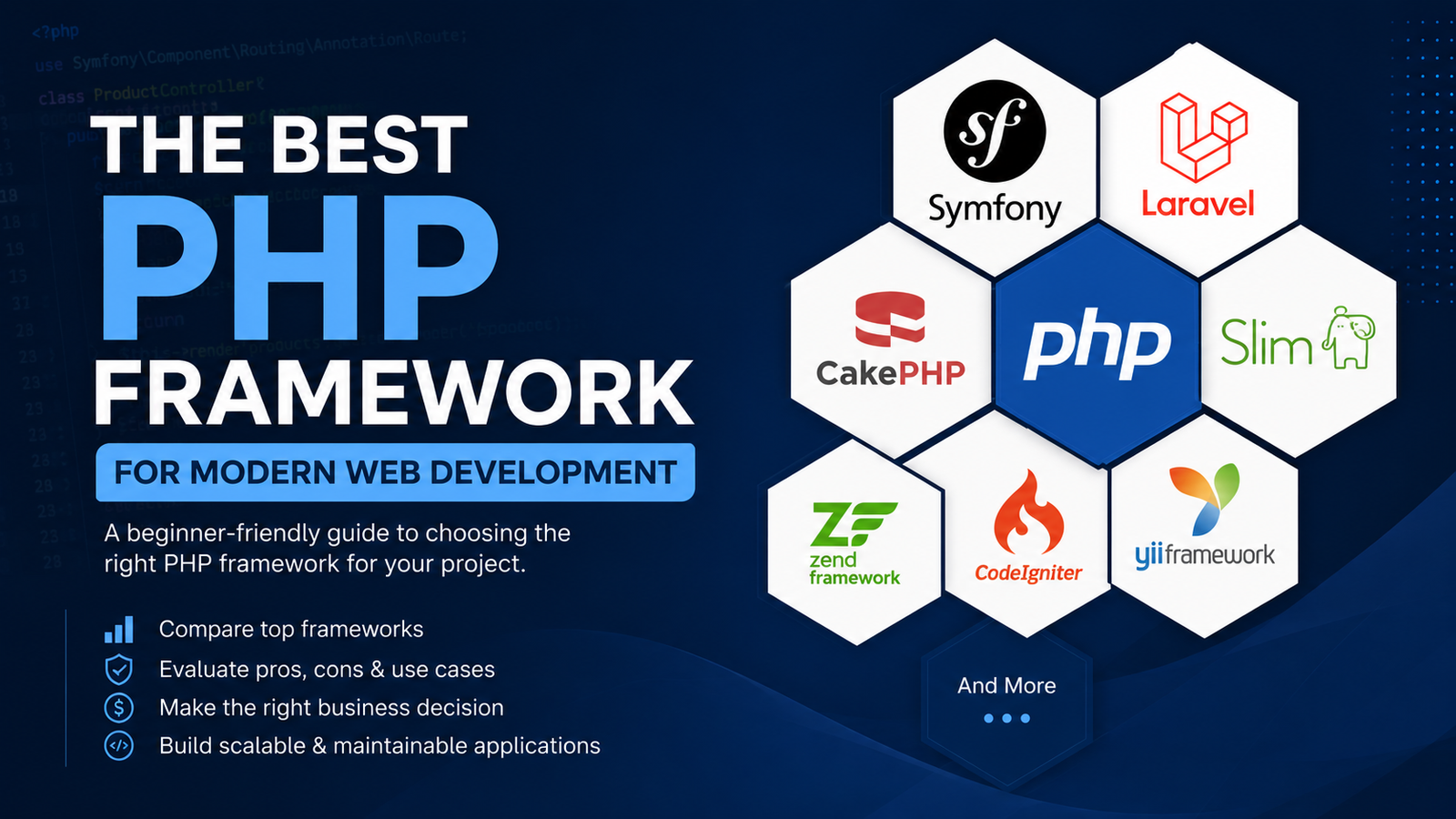
The Best PHP Framework for Modern Web DevelopmentChoosing the best PHP framework can be surprisingly difficult.If you're new to PHP development, you'll quickly encounter names such as Symfony, Laravel, CakePHP, CodeIgniter, Slim, Yii, and Laminas. Each framework has its own philosophy, ecosystem, learning curve, and ideal use cases.And developers love arguing about which one is best.But from a business perspective, the question shouldn't simply be:"Which PHP framework is the easiest to learn?"A better question is:"Which PHP framework gives me the best foundation for building software that can survive, evolve, and generate value for years?"A framework isn't just a collection of convenient functions. Once you build a significant application around one, it influences your architecture, development speed, hiring options, maintenance costs, infrastructure, and even how easily your business can respond to new requirements.For modern web development, my overall choice is Symfony.That doesn't mean Symfony is automatically the right framework for every project. Laravel can be incredibly productive. Slim is excellent when you deliberately want something small. CakePHP and CodeIgniter still have legitimate use cases. Laminas offers an interesting enterprise-oriented approach.Let's compare them.What Is a PHP Framework?Before comparing frameworks, beginners need to understand what a framework actually does.You can build a web application using plain PHP.For example:<?php$productId = $_GET['id'] ?? null;// Fetch product...// Validate data...// Render HTML...Technically, you could build an entire application this way.The problem appears as the application grows.You suddenly need routing, authentication, authorization, database access, validation, caching, dependency injection, configuration management, queues, logging, error handling, testing, APIs, CLI commands, emails, events, file uploads and dozens of other capabilities.You could implement all of these yourself.Usually, you shouldn't.A PHP framework provides conventions and reusable components for solving these recurring engineering problems.Instead of reinventing your application's infrastructure, you can concentrate on the software that actually differentiates your product or business.And that is where framework selection becomes a business decision rather than simply a technical preference.Here’s a cleaner version without a table:Quick Comparison of the Major PHP FrameworksBefore going deeper into each framework, it helps to understand where they generally fit.Symfony is best suited to complex, long-lived applications where architecture, maintainability, and scalability matter. Its learning curve is relatively high, but it offers excellent flexibility and is particularly strong for large business applications.Laravel focuses heavily on developer productivity and rapid application development. It is easier to approach than Symfony, especially for beginners, while still being flexible enough for serious applications. It is a very strong choice for startups, SaaS products, dashboards, and applications that need to reach the market quickly.CakePHP works particularly well for conventional database-driven applications and CRUD-heavy business software. Its convention-over-configuration philosophy can help teams build applications quickly without making every architectural decision from scratch.Slim is a lightweight micro-framework designed primarily for APIs, microservices, webhooks, and smaller backend services. It is easy to get started with and highly flexible, but building a large application with Slim requires you to make more architectural decisions yourself.Laminas, formerly associated with Zend Framework, is particularly suited to modular and enterprise-oriented PHP applications. It provides strong architectural flexibility, although its learning curve and ecosystem can make it less approachable than Laravel.CodeIgniter is a lightweight and relatively straightforward PHP framework. It can be a good choice for traditional websites, small business applications, and developers who want a simpler framework without too much abstraction.Yii is particularly effective for database-heavy applications and rapid CRUD development. It provides solid performance and useful development tools, although it currently has less ecosystem momentum than Symfony or Laravel.Nette focuses on structured application development, security, and clean architecture. It is a capable framework, especially in markets where it already has an established developer community.Phalcon has historically differentiated itself through its focus on performance. It can be attractive for specialized performance-sensitive applications, although framework execution speed alone should rarely determine a business technology decision.There is no PHP framework that dominates every category.Laravel may be better when speed of development is the main objective. Slim may be ideal for a small API. CakePHP or CodeIgniter may be perfectly sufficient for a conventional business application.But when maintainability, architecture, flexibility, scalability, and long-term business requirements become important, Symfony becomes particularly compelling.That is ultimately why Symfony stands out as my overall choice for modern PHP development.1. SymfonySymfony is one of the most mature and influential frameworks in the PHP ecosystem.It is especially interesting because Symfony is simultaneously a full-stack framework and a collection of independent PHP components.You can build an entire application with Symfony, or use individual Symfony components inside another project.Its ecosystem includes components for routing, dependency injection, HTTP handling, forms, validation, serialization, caching, security, console applications, workflows, messaging and much more.This modularity is one of Symfony's greatest strengths.Why Symfony Stands OutSymfony encourages developers to think about software architecture.Instead of hiding too much of the underlying application from you, Symfony gives you powerful abstractions while still making it possible to understand what is happening.A typical controller can remain extremely simple:#[Route('/products/{id}', name: 'product_show')]public function show(Product $product): Response{ return $this->render('product/show.html.twig', [ 'product' => $product, ]);}Behind that small controller, however, you can build sophisticated architectures involving services, repositories, events, message queues, domain models and external systems.Symfony also integrates naturally with technologies commonly used in professional PHP applications, including Doctrine ORM and Twig.Symfony Is More Than a FrameworkOne important thing beginners may not immediately realize is how much of the PHP ecosystem relies on Symfony components.Other frameworks and applications use Symfony packages internally.That means learning Symfony concepts can teach you skills that remain useful beyond Symfony itself.Understanding dependency injection, services, events, HTTP abstractions, console commands and structured application architecture makes you a stronger PHP developer in general.Symfony for Business ApplicationsSymfony becomes particularly attractive when an application is expected to live for years.Imagine building:a custom CMS;an e-commerce platform;a SaaS product;an internal business application;an ERP;a marketplace;a large REST API;an automation platform;or a collection of interconnected services.These applications rarely remain simple.Business requirements evolve.You add integrations.You introduce asynchronous processing.Permissions become more complicated.Data volumes increase.New developers join the project.The architecture that seemed unnecessary during month one can become extremely valuable during year three.Symfony gives you a strong foundation for that evolution.The Disadvantage: Symfony Requires More LearningSymfony isn't necessarily the easiest PHP framework for a complete beginner.You will encounter concepts such as:dependency injection;service containers;interfaces;events;configuration;Doctrine entities;repositories;autowiring;message buses;application architecture.Initially, Laravel may feel easier.But that additional learning isn't necessarily wasted complexity.If your objective is becoming a professional backend developer rather than simply launching your first PHP application, many of those concepts are precisely what you should learn.Symfony VerdictBest overall choice for serious, maintainable and long-lived PHP applications.2. LaravelLaravel is probably the strongest competitor to Symfony when discussing modern PHP frameworks.It has become enormously popular partly because it makes common development tasks extremely pleasant.Laravel provides an integrated ecosystem for routing, authentication, queues, jobs, events, database access, migrations, notifications, caching, testing and much more.For beginners, Laravel can feel immediately productive.Laravel's Biggest Advantage: Developer ExperienceLaravel is designed around developer productivity.You can create routes quickly:Route::get('/products/{product}', function (Product $product) { return view('products.show', [ 'product' => $product, ]);});Database operations with Eloquent can also be remarkably concise:$products = Product::where('active', true) ->orderBy('created_at', 'desc') ->get();This simplicity matters.A startup doesn't receive additional revenue because its developers wrote more complicated code.If Laravel allows a team to validate a business idea in three months instead of six, that development speed has genuine economic value.Laravel's EcosystemLaravel's ecosystem is another major advantage.There are tools and packages covering deployment, authentication, queues, billing, administration, monitoring and many other common requirements.This makes Laravel particularly attractive for SaaS products, startups, dashboards, CRUD applications and projects where time-to-market is critical.Laravel vs SymfonyLaravel and Symfony aren't complete opposites.In fact, Laravel uses several Symfony components.The difference is largely philosophical.Laravel generally optimizes for developer experience and rapid productivity.Symfony tends to expose a more explicit and highly configurable architecture.For many small and medium-sized applications, Laravel's approach can be preferable.For large applications where I want tight control over architecture and long-term maintainability, I would personally choose Symfony.Laravel VerdictBest PHP framework for rapid development and one of the best choices for beginners who want to build real applications quickly.3. CakePHPCakePHP has been around since 2005, making it one of PHP's long-established frameworks.Its philosophy emphasizes convention over configuration.Instead of requiring developers to make architectural decisions about everything, CakePHP provides conventions that allow applications to be developed relatively quickly.That can be particularly effective for applications centered around databases and CRUD operations.CRUD means:Create, Read, Update and Delete.Many business applications ultimately contain significant amounts of CRUD functionality.Think about an inventory system where employees create products, update quantities, view orders and delete obsolete records.CakePHP can work very well for this type of application.Why Choose CakePHP?CakePHP provides many features out of the box and has historically focused on rapid application development.Its conventions can also help teams maintain consistency.The tradeoff is that CakePHP has a smaller mindshare today than Laravel or Symfony.For a new strategic project, ecosystem size and hiring availability are legitimate business considerations.CakePHP VerdictA mature framework that remains relevant, particularly for conventional database-driven applications.4. Slim FrameworkSlim takes a very different approach.Slim is a micro-framework.Instead of providing almost everything required for a large application, it gives you a lightweight foundation for handling HTTP requests, routing and middleware.For example:$app->get('/api/products/{id}', function ($request, $response, $args) { // Retrieve product... return $response;});Simple.That's exactly the point.Where Slim Makes SenseSlim can be excellent for:small REST APIs;microservices;internal services;webhooks;lightweight backend applications;prototypes.If you need a tiny HTTP service receiving a webhook, processing some information and sending it elsewhere, installing an enormous application architecture may be unnecessary.Slim lets you choose the additional libraries you need.The Hidden Cost of MinimalismMinimal frameworks introduce another problem.They give you freedom.But freedom means making decisions.Which ORM?Which dependency injection container?Which validation library?Which authentication system?Which serialization solution?Which architectural conventions?Experienced developers may love that flexibility.Beginners can accidentally create inconsistent architectures because the framework isn't providing enough guidance.Slim VerdictExcellent for lightweight APIs and developers who intentionally want to assemble their own stack.5. Zend Framework / LaminasIf you've been researching PHP for a while, you may encounter Zend Framework.There's an important historical distinction to understand.Zend Framework was transitioned into the Laminas Project.Therefore, when evaluating the ecosystem today, you should generally be looking at Laminas rather than treating Zend Framework as a modern framework you would start a new application with.Laminas provides modular packages and follows a professional, enterprise-oriented philosophy.Like Symfony, it can appeal to developers who want explicit architecture and reusable components.Why Consider Laminas?Laminas can make sense for enterprise environments and existing applications already built around the Zend/Laminas ecosystem.However, for a completely new project, I would generally prefer Symfony because of its ecosystem, documentation, community and broad adoption.Zend/Laminas VerdictImportant PHP technology with strong enterprise roots, but Symfony would usually be my choice for a new project requiring similar architectural sophistication.6. CodeIgniterCodeIgniter has been popular partly because of its simplicity.It provides a relatively lightweight approach to building PHP applications without introducing as much conceptual overhead as some larger frameworks.That makes it approachable.You can learn the fundamentals of MVC and create database-backed applications without immediately dealing with every architectural concept found in larger frameworks.Where CodeIgniter Makes SenseCodeIgniter can still be useful for:small business applications;traditional websites;simple dashboards;lightweight CRUD systems;developers wanting a straightforward PHP framework.Its simplicity is both an advantage and a limitation.As your application's architecture becomes increasingly complicated, you may appreciate the more extensive tooling and conventions available in Symfony or Laravel.CodeIgniter VerdictA straightforward and lightweight option, especially for relatively simple applications.7. YiiYii is another mature PHP framework designed with performance and rapid development in mind.It provides features such as MVC architecture, database abstraction, caching, validation and authentication.One of Yii's historically attractive features has been its ability to accelerate CRUD-oriented development.Yii can therefore be perfectly capable of powering serious web applications.The primary question for a new project isn't whether Yii works.It does.The question is whether choosing it provides enough advantages over Symfony or Laravel to justify selecting a smaller ecosystem.For some teams, the answer will absolutely be yes.For many others, Symfony or Laravel will simply represent a safer default.Yii VerdictA capable mature framework, particularly suited to database-heavy web applications, but with less ecosystem momentum than Symfony and Laravel.8. NetteNette deserves mention because PHP's framework ecosystem is broader than the handful of names dominating English-language discussions.Nette emphasizes clean architecture, security and developer productivity.It has historically maintained particularly strong adoption in Central Europe.For developers working within an existing Nette ecosystem, it can be an excellent framework.However, ecosystem geography matters from a business perspective.If your company expects to recruit developers internationally, framework popularity can influence how easily you can expand your engineering team.Nette VerdictA solid and well-designed framework whose attractiveness depends significantly on your market and existing development ecosystem.9. PhalconPhalcon became famous for approaching PHP framework performance differently from conventional frameworks.Historically, much of Phalcon's functionality was implemented closer to the PHP runtime through an extension rather than entirely as ordinary PHP packages.This performance-oriented philosophy made Phalcon technically interesting.But performance should never be evaluated in isolation.For most businesses, framework execution speed is only one part of application performance.Databases, caching, network calls, architecture, infrastructure, frontend performance and application design frequently matter much more.A framework saving a few milliseconds doesn't automatically compensate for a smaller ecosystem or increased operational complexity.Phalcon VerdictTechnically interesting and performance-oriented, but a specialized choice compared with Symfony or Laravel.Other PHP Frameworks Worth KnowingPHP has a long history, and there are many additional frameworks and micro-frameworks worth knowing about.Depending on the project, you may encounter:Flight;Fat-Free Framework;Mezzio;Spiral;FuelPHP;PHPixie;Aura;various PSR-based component stacks.You don't need to learn all of them.Understanding that they exist is useful because it demonstrates something important about modern PHP:PHP development is not synonymous with Laravel.The ecosystem offers everything from tiny routers to highly structured enterprise frameworks.Symfony vs Laravel: The Decision Most Developers Actually Need to MakeFor most developers starting a substantial new PHP application, I would narrow the decision fairly quickly to:Symfony vs Laravel.Both are mature.Both have substantial ecosystems.Both can build serious applications.Both support modern PHP.Both can power APIs, SaaS products, websites, administration systems and complex business applications.The difference comes down to priorities.Choose Laravel when you prioritize:rapid development;approachable syntax;excellent developer experience;startup velocity;a highly integrated ecosystem.Choose Symfony when you prioritize:explicit architecture;long-term maintainability;modularity;complex business logic;extensive configuration;enterprise applications;architectural control.Neither choice makes someone a better developer.They're tools optimized around somewhat different priorities.Why Framework Choice Is a Business DecisionDevelopers frequently compare frameworks using technical features.Businesses should evaluate something broader.Suppose Framework A lets you build your MVP 20% faster, but Framework B makes a large application significantly easier to maintain five years later.Which framework is cheaper?There isn't enough information to answer.For a startup that has six months of cash remaining, development velocity might dominate every other consideration.For a company replacing an internal system expected to operate for the next decade, maintainability may matter much more.When evaluating a framework professionally, I would consider:Development velocity. How quickly can the team deliver useful features?Maintenance cost. How difficult will the software become to modify?Developer availability. Can you recruit developers familiar with the ecosystem?Package ecosystem. Are mature libraries available for common business requirements?Upgrade strategy. Can the application realistically remain supported for years?Architecture. Does the framework help or hinder the complexity you expect?Documentation. Can developers solve problems without spending hours reverse-engineering the framework?Security. Does the framework provide mature mechanisms for authentication, authorization, validation and common web security concerns?Testing. Can your team build reliable automated tests?Integration. How easily can the application communicate with queues, APIs, databases, search engines and other infrastructure?These considerations are considerably more important than arguing over which framework has the prettiest syntax.What Is the Best PHP Framework for Beginners?This creates an interesting distinction.If someone asks me:"What is the easiest major PHP framework for a beginner to start building applications with?"I would seriously consider Laravel.Its developer experience makes it possible to become productive relatively quickly.But if the question becomes:"Which PHP framework should I learn deeply if I want to understand professional application architecture?"My answer changes.I would choose Symfony.Symfony forces you to encounter concepts that extend beyond one framework.You'll learn about dependency injection, HTTP abstractions, object-oriented design, ORM patterns, service architecture, events, messaging and separation of concerns.Those skills transfer.And transferable knowledge is enormously valuable throughout a developer's career.What Is the Best PHP Framework for a Startup?Laravel is extremely compelling here.Startups operate under uncertainty.You may spend six months designing a perfect architecture for a product nobody wants.That's worse than launching an imperfect application in six weeks and discovering whether customers actually care.Laravel's productivity can therefore become a competitive advantage.However, Symfony shouldn't automatically be dismissed for startups.If the founding team already understands Symfony well, switching to Laravel purely because someone claims it's faster would make little sense.The framework your team knows extremely well can often outperform the theoretically optimal framework.What Is the Best PHP Framework for Enterprise Applications?This is where Symfony becomes particularly strong.Enterprise applications tend to accumulate complexity.Permissions.Workflows.Integrations.Queues.Background jobs.Multiple databases.External APIs.Complex domain rules.Long maintenance cycles.Large engineering teams.Symfony's explicit architecture and modular ecosystem work extremely well under those conditions.Laminas can also be considered in enterprise environments, particularly where an organization already has Zend/Laminas expertise.But for a greenfield enterprise PHP application, Symfony would be my default recommendation.What Is the Best PHP Framework for APIs?There isn't one answer.For a small API or microservice:Slim can be excellent.For an API connected to a larger business application:Symfony or Laravel will usually provide more infrastructure.Symfony also becomes particularly interesting when combined with API-oriented tooling from the broader PHP ecosystem.The correct decision depends on whether you're building five endpoints or five hundred.What Is the Fastest PHP Framework?Beginners often focus heavily on benchmarks.Be careful.A framework handling more synthetic requests per second doesn't necessarily mean your actual application will be faster.Imagine an e-commerce endpoint that takes:3 ms inside the framework;40 ms querying the database;80 ms calling an external service.Optimizing framework overhead by 1 ms isn't your primary problem.Application performance is a systems problem.Caching strategy, database indexes, SQL queries, network latency, HTTP caching, queues, infrastructure and frontend optimization can have much larger effects than framework choice.Choose architecture first.Benchmark your real application second.Optimize actual bottlenecks third.Should You Build Without a Framework?Sometimes.A tiny PHP script doesn't need Symfony.Neither does every webhook.Modern PHP's package ecosystem also allows experienced developers to assemble applications from individual PSR-compatible libraries.But there's a hidden cost.When you don't choose a framework, you're effectively designing your own framework.You decide the directory structure.You select the router.You configure dependency injection.You establish database conventions.You define validation.You create error handling.You decide how authentication works.You establish testing patterns.That can be appropriate when you know exactly why you're doing it.For beginners, a mature framework usually provides valuable guardrails.Why Symfony Is My Choice for the Best PHP FrameworkAfter comparing the alternatives, Symfony would be my overall choice for modern PHP development.Not because Symfony wins every benchmark.Not because it requires the fewest lines of code.And certainly not because every project needs it.I choose Symfony because it provides an unusually strong combination of:architecture;modularity;maturity;reusable components;flexibility;long-term maintainability;professional tooling;ecosystem integration;scalability from small applications to complex platforms.Most importantly, Symfony doesn't lock you into thinking exclusively in terms of Symfony.It encourages you to understand the engineering concepts underneath the framework.That's extremely valuable.The Best PHP Framework Depends on What You're BuildingDespite choosing Symfony overall, I wouldn't use Symfony automatically for everything.If I needed a tiny API tomorrow, I might choose Slim.If I wanted to validate a SaaS idea as quickly as possible, Laravel would be extremely attractive.If I inherited a well-built CakePHP application generating significant revenue, I certainly wouldn't rewrite it simply because Symfony is my preferred framework.Technology decisions should support business objectives.Not developer ego.The best framework is the one that minimizes the technical and economic risks of the software you're actually building.Final VerdictIf you're a beginner choosing your first PHP framework, don't obsess over finding a universally perfect framework.It doesn't exist.Laravel is an excellent starting point if your priority is getting productive quickly.Slim is excellent when minimalism is intentional.CakePHP and CodeIgniter remain capable choices for conventional applications.Yii and Nette demonstrate that there are mature alternatives outside the Symfony/Laravel duopoly.Laminas carries forward the enterprise-oriented heritage of Zend Framework.But if I had to choose one PHP framework for modern web development, especially for applications expected to become serious business assets, my choice would be:Symfony.The initial learning curve is higher.That's also part of its value.Symfony teaches you more than how to build a PHP website. It gives you a foundation for understanding how large backend applications are structured.For a developer, that knowledge compounds.For a business, good architecture compounds too.And when you're building software expected to survive years of new features, integrations, developers and changing business requirements, that foundation matters far more than saving a few minutes when creating your first controller.
Read article